Guide · updated November 12, 2026
Blue-Green Algae in Lakes: Is It Safe to Swim?
How to spot a harmful algal bloom, what EPA’s CyAN satellite readings can and cannot tell you, and what to do if you or your dog swam in one.
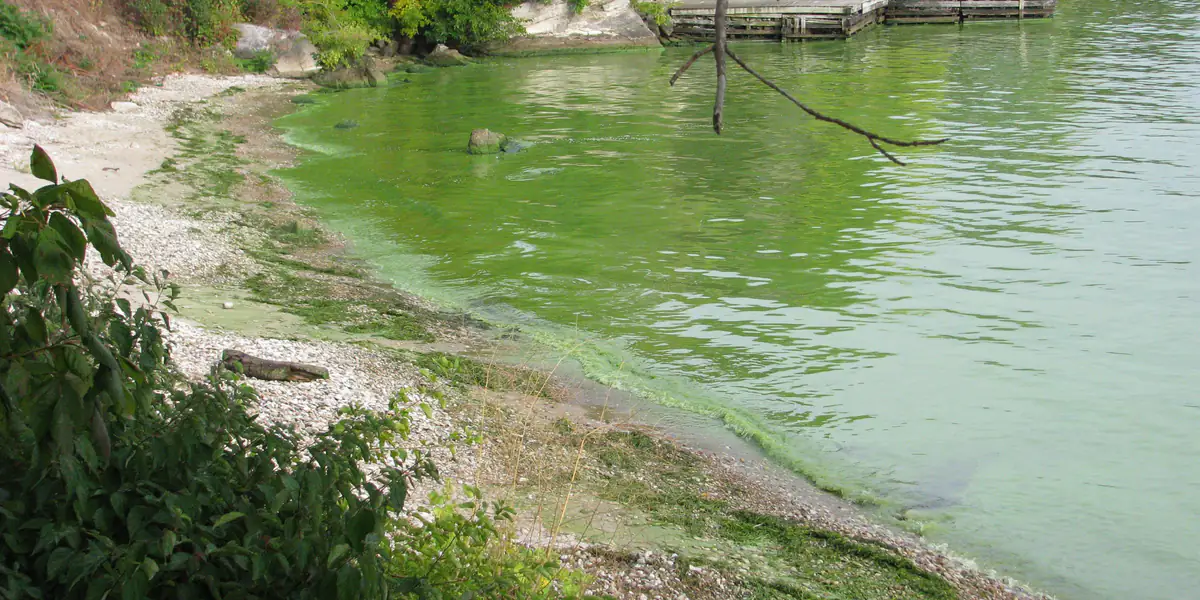
Most green water in a lake is harmless. Cyanobacteria — often called blue-green algae — are different: in warm, still, nutrient-rich water they can multiply into a harmful algal bloom and produce toxins such as microcystin. Blooms are most common from late spring to early fall, after calm, hot spells and in shallow bays where the wind piles them up.
How to recognize a bloom
- Water that looks like spilled green paint or pea soup, or has blue-green, brown or red streaks.
- Scum or a foamy mat on the surface, often along the downwind shore.
- Floating clumps, dots or grass-clipping-like specks in the water.
- A musty or rotten smell.
When in doubt, stay out — and keep children and dogs out too.
What the satellite sees
The U.S. Environmental Protection Agency’s Cyanobacteria Assessment Network (CyAN) reads the color of lakes from the European Sentinel-3 satellites. From the light reflected by the water it estimates how many cyanobacteria cells are at the surface. Lake by Lake shows the latest clear reading and the past weeks on each lake page where CyAN has data.
Know its limits:
- Only big, open water. Each satellite pixel is about 300 m across, so small lakes, narrow arms, coves and the shoreline — where blooms often collect — are not measured.
- Only the surface. Cyanobacteria can sit below the surface and rise in the afternoon.
- Clouds, ice and glare hide the lake on some days; the reading then dates from the last clear pass.
- Not an advisory. Beach closures and health warnings come from state and local agencies, which also test the water.
How to read the levels
CyAN rates each lake by the worst spot its satellites see, in cyanobacteria cells per milliliter:
| Level | Cells per milliliter |
|---|---|
| Low | under 100,000 |
| Moderate | 100,000 to 300,000 |
| High | 300,000 to 1,000,000 |
| Very high | over 1,000,000 |
Because one hotspot sets the level, Lake by Lake also shows how much of the lake has cyanobacteria: a “very high” reading over 2% of a big reservoir is a bloom in one bay, not across the lake. As a reference, the World Health Organization’s guidelines for recreational water put a relatively low risk of health effects below about 20,000 cells/mL and a moderate risk around 100,000 cells/mL. A moderate or higher reading is a reason to look at the water carefully and check for an advisory before swimming, letting dogs in or water-skiing through it.
If you or your dog came into contact
- Rinse off with clean water as soon as you can, and wash swimsuits.
- Wash your dog with clean water and keep it from licking its fur.
- Watch for symptoms: skin rash, eye irritation, vomiting or diarrhea in people; drooling, vomiting, weakness or seizures in dogs. Call a doctor, a veterinarian or poison control.
- Report the bloom to the state environment or health agency, with a photo and the location.
Fish and drinking water
Do not drink untreated lake water during a bloom — boiling and camping filters do not remove the toxins. Fish caught in a bloom can carry toxins in their organs; clean them well, eat only the fillets and follow any state advisory.
Questions
Is it safe to swim in a lake with blue-green algae?
Not where the water looks like spilled paint or pea soup, has scum on top, or where the state has posted an advisory. Cyanobacteria can make toxins that cause rashes, stomach illness and, in dogs, fatal poisoning. Elsewhere on the same lake the water may be fine — blooms are patchy and move with the wind.
What does a CyAN satellite reading tell me?
How much cyanobacteria the Sentinel-3 satellites detect at the surface of the open water, in cells per milliliter, and over how much of the lake. It is an early warning for large lakes, not a swimming advisory, and it cannot see coves, the shoreline or under the surface.
Are algae blooms dangerous for dogs?
Yes, more than for people. Dogs swim in scummy water, drink it and lick it off their fur, and some cyanobacteria toxins act within hours. Keep dogs out of discolored water and rinse them with clean water if they go in.
Does boiling or filtering lake water remove algae toxins?
No. Boiling can release more toxin from the cells, and camping filters do not remove dissolved toxins. Do not drink untreated lake water during a bloom.