Guide · updated November 11, 2026
Boat Ramp Too Shallow? Launching at Low Water
How the lake level decides whether a boat ramp works, what a ramp’s minimum usable level means, and how to launch safely when a reservoir is low.
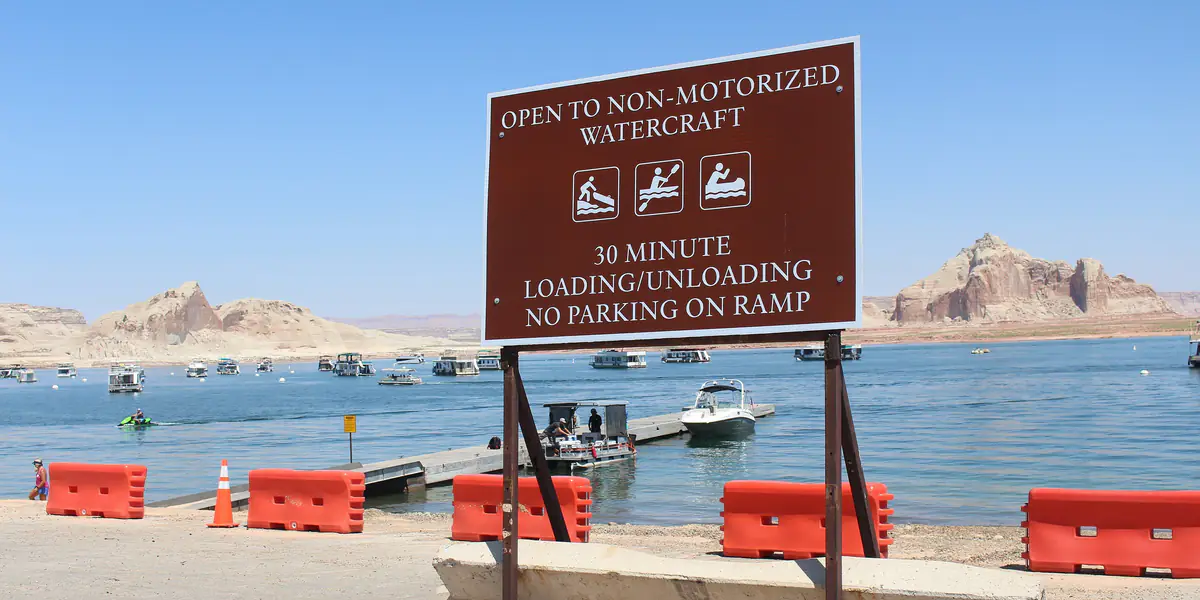
A boat ramp is a slab of concrete laid down the shore at a fixed height. The lake moves; the ramp does not. When a reservoir draws down in a dry summer or for its winter pool, the end of the ramp can end up in a few inches of water — or out of it.
Why the lake level decides whether you can launch
Each ramp has a toe: the bottom end of the concrete. To launch, the trailer has to back far enough for the boat to float off while its wheels are still on the slab. The water over the toe is what matters:
- Plenty of water over the toe — normal launch.
- Shallow water over the toe — the boat floats only if you back the trailer off the end of the concrete. Wheels drop off the edge and the trailer can get stuck.
- Toe out of the water — the ramp is closed, or only usable by kayaks and canoes carried by hand.
Some operators publish a minimum usable level for each ramp: the lake level at which there is still enough water over the toe. On Lake Lanier, the U.S. Army Corps of Engineers lists one for every public and marina ramp, and Lake by Lake compares it with the live lake level every hour.
How to check before you tow
- Look up today’s level on the lake page, and the trend over the past week. A lake dropping a tenth of a foot a day loses a foot in ten days.
- Compare it with full pool. A lake within a couple of feet of full pool has every ramp working. Ten feet down, the shallow ramps are usually out.
- Check the ramp list for the lake. Where a minimum level is published, you can see how much depth is to spare. Elsewhere, pick the ramps at the main body of the lake and near the dam, which sit in deeper water than those at the ends of coves.
- Call the marina or the operator if the lake is far below normal. They know which lanes are still open.
Tips for launching at low water
- Use the deepest lane. Many ramps have several lanes of different length; at low water only the longest reaches deep enough.
- Watch the drop-off. The bottom past the end of the ramp is often scoured into a hole. Do not back the trailer off the concrete.
- Mind the courtesy dock. Floating docks can rest on the bottom or tilt at low water, and fixed docks end up high above the water.
- Look for new hazards. Stumps, sandbars and old roadbeds that are normally deep come close to the surface when a reservoir is drawn down. Go slow outside the marked channel.
- Plan the way back. If the lake is dropping fast, a ramp that worked in the morning can be harder to use in the evening — and wind can push water away from one end of a large lake.
When the lake is high
Floods close ramps too: the parking lot or road can be under water, the courtesy dock floats away from its walkway and the ramp fills with drift. Some operators publish a maximum level as well. If the lake is well above full pool, check before you go.
Finding ramps on your lake
Every lake page on Lake by Lake has a map of the shoreline with its boat ramps and marinas, and a link to directions for each one. Ramp locations come from OpenStreetMap and the lake’s operators; names and conditions change, so check posted signs when you arrive.
Questions
How deep does the water need to be at the end of a boat ramp?
Enough to float the boat off the trailer without the trailer wheels dropping off the end of the concrete. For most bass boats and small runabouts that means at least 2 to 3 feet of water over the end of the ramp; bigger cruisers and pontoons need more.
What is a ramp's minimum usable level?
The lake level below which the end of the ramp sits too close to the surface to launch safely. Some operators, like the Corps of Engineers at Lake Lanier, publish it for every ramp. Compare it with today's lake level to know if the ramp works.
Why do ramps close when the lake is low?
When the water drops below the end of the concrete, trailers roll onto mud, sand or a sharp drop-off. Operators close the ramp, or block the lower lanes, to keep trailers from getting stuck and boats from hitting bottom.
Can a ramp be closed because the lake is too high?
Yes. In a flood, the parking lot, courtesy dock or approach road can go under water, and debris builds up at the ramp. Many ramps close above a certain level too.