Guide · updated November 10, 2026
Solunar Fishing Times, Explained
What the major and minor periods are, how they are calculated from the moon, and how much to trust them on your lake.
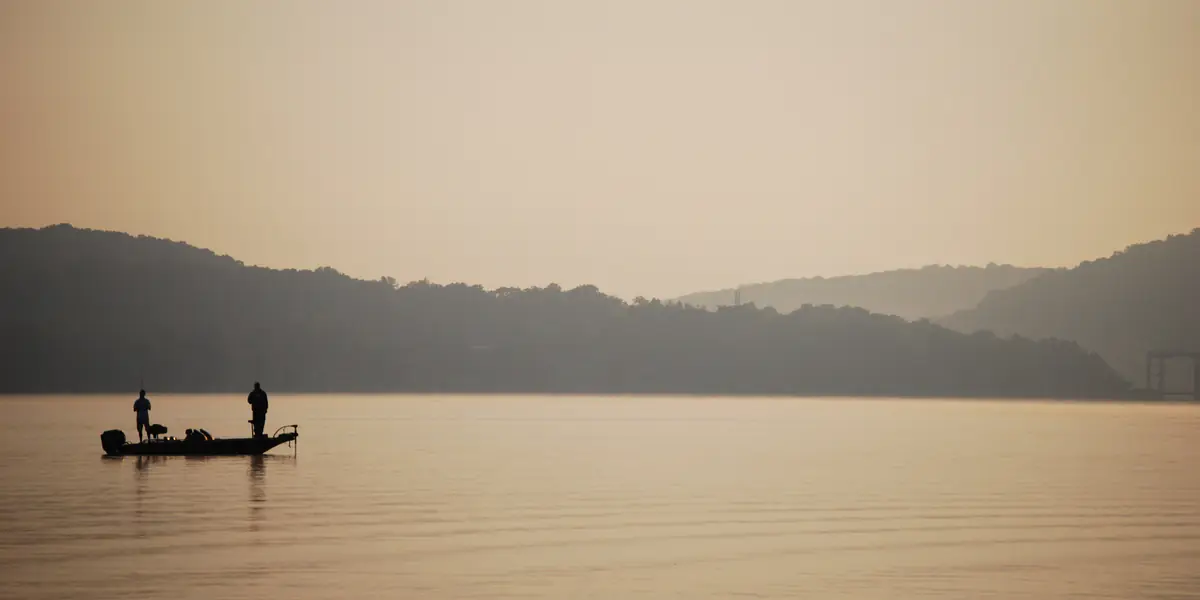
The solunar theory, published by John Alden Knight in 1926, says fish and game are most active at certain times of day set by the position of the moon. Every lake page on Lake by Lake lists those times for today, calculated for the lake’s exact location.
Major periods
A major period lasts about two hours, centered on the moment the moon is directly overhead (upper transit) or directly underfoot (lower transit). There are usually two a day, about 12 hours and 25 minutes apart.
Minor periods
A minor period lasts about one hour, centered on moonrise or moonset. Some days have only one, because the moon rises or sets once in 24 hours and 50 minutes.
How the day is rated
We rate each day from one to four stars by the moon phase: four stars within a couple of days of a new or full moon, one star near the first and last quarter. When a major or minor period falls at sunrise or sunset, many anglers consider it the best window of the day.
How we calculate it
Lake by Lake uses the astronomy-engine library to compute moon transits, moonrise and moonset for each lake’s latitude and longitude, then converts them to the lake’s time zone. The numbers are astronomical facts; whether the fish follow them is up to the fish.
What matters more than the moon
- Barometric pressure — a falling barometer before a front often triggers feeding; a sharp rise after it shuts it down.
- Water temperature — bass feed most between about 60 °F and 75 °F.
- Light — low light at dawn and dusk.
- Lake level and current — rising water pushes bait into fresh cover; generation releases at the dam create current that fish key on.
Check the weather and the lake level on the same page before you head out.
Questions
Do solunar tables really work?
Studies are mixed. Many anglers find fish more active around dawn, dusk and the major periods, but weather, water temperature and pressure changes usually matter more. Treat the periods as a tiebreaker when you can choose when to go.
Why are the times different for my lake and my friend’s lake?
The moon crosses each meridian at a different time, and moonrise depends on latitude. Lake by Lake calculates the periods for each lake’s own coordinates and time zone.
Which days are best?
Days around the new moon and the full moon are rated highest, because that is when the sun and moon pull together. Days near the quarter moons are rated lowest.