Guide · updated November 17, 2026
Why Is the Lake So Low? Drawdowns, Drought and Dam Releases
Why a lake sits below full pool: planned winter drawdowns, drought and evaporation, releases for power, barges and cities, and dams under repair.
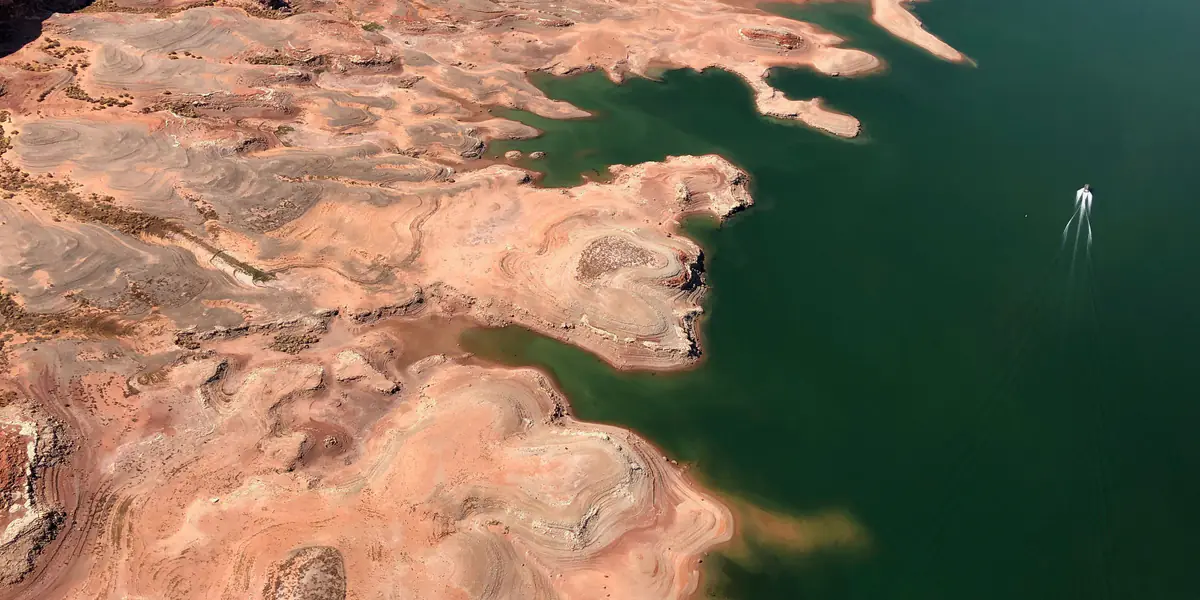
Most of the U.S. lakes with a daily water level are reservoirs: lakes made by a dam and run by someone, whether the Army Corps of Engineers, the Bureau of Reclamation, the Tennessee Valley Authority, a power company or a water district. Their level is supposed to move. A low lake is not always a problem, and the reason behind it decides how long it will last.
The plan: a target level for every day
Each reservoir is run to a plan that sets the level to aim for on each day of the year. The Corps calls it a guide curve or rule curve. It balances what the dam was built for, usually flood control, hydropower, water supply, navigation and recreation, against the season.
So “low” can mean two different things. Below full pool (see what full pool means) is normal for much of the year on many lakes. Below the level the plan calls for today is what tells you something unusual is going on.
Planned winter drawdowns
The most common reason a lake is low is that it is meant to be. Flood-control reservoirs are lowered every fall so the winter and spring rains have room to go. On the Tennessee River system, TVA speeds up releases from its tributary reservoirs after Labor Day, brings them down at least to their winter flood-guide levels by January 1, and starts filling them again in March to reach summer levels by June 1. Corps reservoirs across the South and Midwest follow a similar yearly cycle; Lake Cumberland can swing 50 feet in a year.
Some northern lakes are lowered in winter for other reasons: to keep ice from heaving docks and shorelines, or to expose and freeze weeds in the shallows.
Drought and evaporation
In a dry year less water comes in, but the dam still has to send water downstream for cities, farms, power plants, river navigation and fish. The lake makes up the difference. In the West, hot, dry air also evaporates a lot of water off a big reservoir every summer.
The result can be dramatic. Lake Lanier fell about 20 feet below full pool in December 2007 and did not refill until October 2009. Lake Mead and Lake Powell, after more than two decades of drought on the Colorado River, have both fallen well over 100 feet below full, leaving a pale “bathtub ring” on the canyon walls.
Releases downstream
Dams release water every day, and some releases change the level fast:
- Hydropower: dams that make electricity at the hours of highest demand can move a lake up and down every day.
- Navigation: big reservoirs upstream keep rivers deep enough for barges, as on the Missouri and the Tennessee.
- Water supply and irrigation: in summer, when the cities and farms downstream use the most water.
- The river itself: minimum flows for fish and for the people who use the river below the dam.
Repairs and dam safety
Sometimes a lake is held low for years. In January 2007 the Corps began lowering Lake Cumberland over fears that seepage under Wolf Creek Dam could cause a breach; it went back to its usual operating levels only in 2014, after a new barrier wall was built into the rock. Lake Isabella in California was capped about 20 feet below full pool from 2006 until a dam safety project was finished in the early 2020s.
How to tell what is going on with your lake
Every lake page on Lake by Lake shows today’s level against full pool and the change over the last 7 days. On lakes with a long record it also shows the level that is normal for the date, and the history page shows the usual level month by month and the lowest and highest years. A lake far below its normal for the date is in a drought or under special operations; a lake on its normal curve is just in its winter season. For anything unusual, the operator’s own notices have the reason.
Questions
Why do they lower lakes in the winter?
Mostly to make room for floods. Winter and spring storms bring the most runoff in much of the country, so flood-control reservoirs are drawn down in fall to have empty space ready to catch it, then refilled for the summer boating season. Some northern lakes are also lowered to limit ice damage to docks and shorelines.
Is my lake low because of a drought?
Compare today's level with what is normal for the date, not with full pool. A reservoir sitting 8 feet below full pool in January may be right on its winter target; the same level in July usually means a dry year or heavy releases downstream. Lake by Lake shows the usual level for the date on lakes with a long record.
When will the lake fill back up?
When enough rain or snowmelt reaches it, and when the operator's plan allows. TVA, for example, starts holding water in its tributary reservoirs in March to reach summer levels by June 1. In a drought a big reservoir can take years to recover.
Why does my lake go up and down every day?
Usually because of hydropower. Many dams run their turbines when demand for electricity is highest, so the lake drops during the day and recovers at night or on weekends, and a lake between two dams can also rise and fall with releases from the dam upstream.