Guide · updated November 12, 2026
Ice-Out on Northern Lakes, Explained
What ice-out means, how each lake calls it, what sets the date, why anglers watch it and how much ice it takes to walk on.
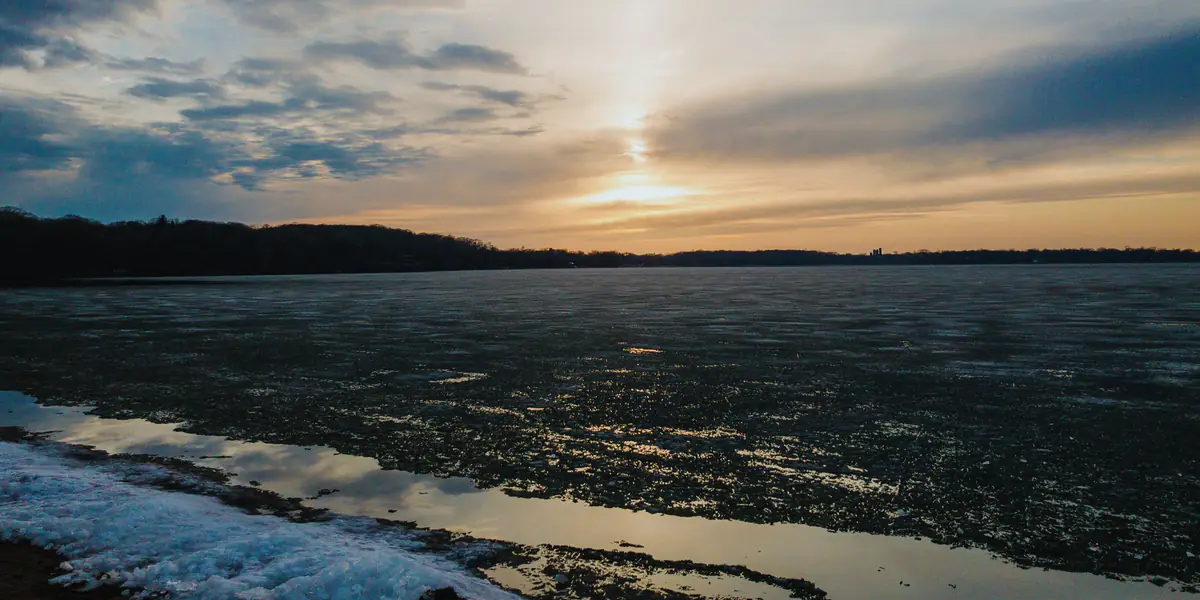
Ice-out is the day a frozen lake opens up in spring. For people who live around northern lakes it is a calendar event: it starts the boating season, sets the timing of the walleye and pike spawn, and decides when docks can go back in.
How ice-out is called
There is no single definition. Each lake keeps its own:
- Minnesota: the Department of Natural Resources collects the dates reported by local observers for hundreds of lakes, some going back to the 1800s.
- Lake Mendota and Lake Monona (Wisconsin): the State Climatology Office keeps records that start in the 1850s, judged the same way every year.
- Other lakes go by the first trip of a ferry, a marker buoy or the view from a fixed spot on shore.
Because the rule stays the same on each lake, long records can be compared year to year even if they cannot be compared lake to lake.
What sets the date
- Air temperature in March and April is the biggest factor: a run of warm days with sun and wind breaks the ice up fast.
- Snow on the ice reflects sunlight and slows the melt.
- Ice thickness from the winter, the size and depth of the lake, and wind, which pushes rotten ice to the shore.
- Latitude and elevation: lakes in southern Minnesota open weeks before those near the Canadian border.
On Lake by Lake, lakes with an ice record show the median ice-out date, the earliest and latest on record and the last springs on a timeline — see Lake Mendota or Mille Lacs Lake.
Why anglers watch it
Walleye, northern pike and yellow perch spawn soon after the ice goes out, when the water is in the 40s °F. Shallow, dark-bottomed bays warm first and draw fish early; the main lake follows. Many states time their fishing openers around these weeks, so check the regulations for the season dates.
A shorter ice season
Long records show ice seasons getting shorter. A study of lakes and rivers across the Northern Hemisphere from 1846 to 1995 found breakup about 6.5 days earlier per century and freeze-up about 5.8 days later. On Lake Mendota, whose record starts in the 1850s, recent winters have had some of the shortest ice seasons on record.
Stay off spring ice
Ice that looks solid in late winter can be honeycombed and weak, especially near shore, inlets and pressure ridges. As a guide for new, clear ice, the Minnesota DNR recommends at least 4 inches to walk on, 5–7 inches for a snowmobile or ATV, 8–12 inches for a car or small pickup and 12–15 inches for a medium truck — and more for white or slushy ice. Near ice-out, no thickness is safe.
Questions
What does ice-out mean?
The day a lake is considered free of ice in spring. Each lake has its own rule — an observer's call that the lake is open, a boat able to cross it, a ferry back on its route — and records kept the same way for decades show how the date shifts.
When is ice-out on Minnesota lakes?
Mostly between late March in the south of the state and early to mid May in the far north, with Lake of the Woods and Rainy Lake among the last. A warm March can move it weeks earlier; a cold, snowy spring weeks later.
Is ice-out happening earlier?
On average, yes. A study of long records from lakes across the Northern Hemisphere (Magnuson and others, Science, 2000) found breakup about 6.5 days earlier per century and freeze-up about 5.8 days later, and most long records have continued that trend.
How thick does ice need to be to walk on?
The Minnesota DNR's guideline for new, clear ice is at least 4 inches to walk or fish on foot, 5 to 7 inches for a snowmobile or ATV, 8 to 12 inches for a car or small pickup and 12 to 15 inches for a medium truck. Spring ice near ice-out is weaker than it looks: stay off it.