Guide · updated November 17, 2026
Clean, Drain, Dry: Stopping Zebra Mussels and Other Invaders
How zebra and quagga mussels and invasive weeds ride between lakes on boats and gear, and the steps and boat inspections that stop them.
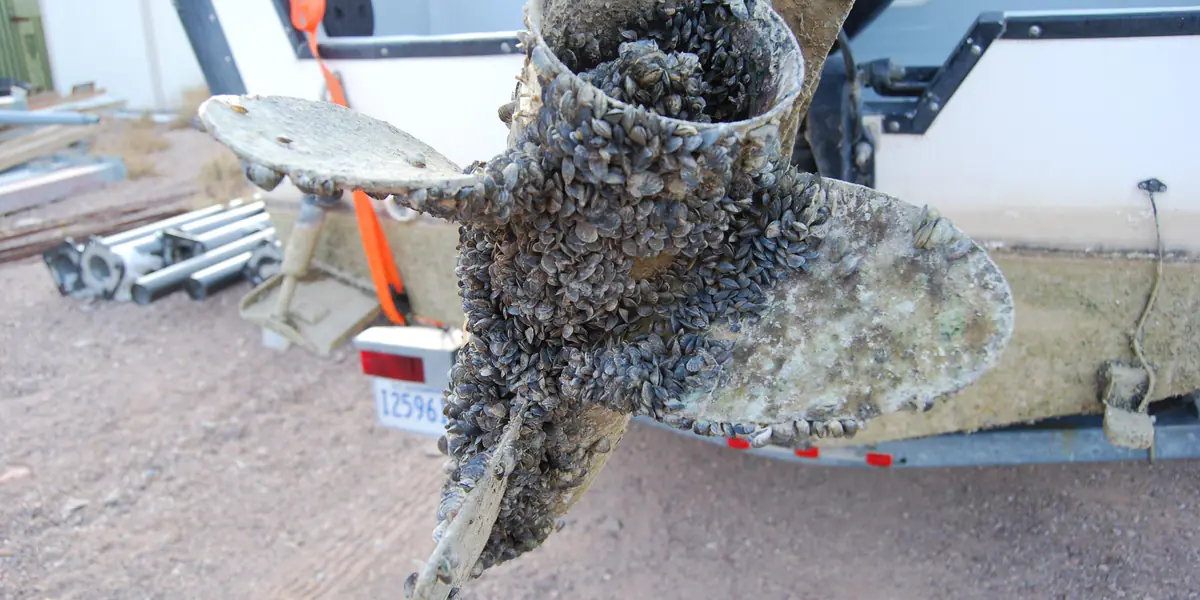
Zebra mussels, quagga mussels, hydrilla, Eurasian watermilfoil and other aquatic invasive species don’t swim from one lake to the next. Most of them travel on boats, trailers and gear. Once established in a lake they are almost impossible to remove, so the whole effort goes into not moving them. The routine is three words long: Clean, Drain, Dry.
What they cost a lake
Zebra mussels reached North America in ship ballast water and were found in Lake St. Clair in 1988; quagga mussels turned up in Lake Mead in 2007, the first find in the West. Both grow in dense layers on anything hard: docks, boat hulls, engine cooling systems, swim beaches, and the intakes that supply drinking water and power plants. They filter huge amounts of plankton out of the water, which changes what the rest of the lake can feed on. Invasive plants such as hydrilla and Eurasian watermilfoil form mats in the shallows that tangle props and crowd out native plants.
Clean
When you take the boat out of the water, before you leave the ramp:
- Pull off every plant, clump of mud and animal from the hull, the motor and lower unit, the trailer bunks and rollers, the anchor and lines.
- Check the places water and weeds collect: the transom, trim tabs, the livewell and the drain plug hole.
- Clean waders, boots, nets and fishing gear the same way; felt soles hold mud and tiny animals for days.
Drain
Mussel larvae, called veligers, are too small to see and can be carried in a few drops of water.
- Pull the drain plug and leave it out while you trailer the boat; many states require it by law.
- Drain the bilge, livewells, bait wells, the motor and, on wake boats, the ballast tanks.
- Empty bait buckets on land, not into the lake, and put unused bait in the trash.
Dry
Let the boat and everything in it dry for at least five days before launching on another lake, and longer in cool, damp weather. Where you can’t wait that long, wash the hull, trailer and gear with hot water (about 140 °F), as several states advise, and flush the motor and compartments.
Inspection and decontamination stations
Many western states, where most lakes are still free of mussels, run boat inspection stations on highways and at ramps, and boaters must stop at open ones. Some lakes inspect every boat before launch; Lake Tahoe inspects every motorized boat. Boats leaving lakes with quagga mussels, such as Lake Mead and Lake Powell, must drain their plugs and, in some cases, be decontaminated with hot water before they leave. An inspection takes a few minutes if the boat arrives clean, drained and dry.
Which lakes already have them
Every lake page on Lake by Lake lists the aquatic invasive species recorded in that lake, from the U.S. Geological Survey’s Nonindigenous Aquatic Species database, together with what the state asks of boaters, under “Before you launch: invasive species”. A species not on the list may still be there, so treat every lake as if it had them, and every lake you go to next as if it didn’t.
Questions
How long should a boat dry to kill zebra mussels?
Five days is the common rule in warm, dry weather. Several states ask for longer in cool or damp weather, because mussel larvae can live for weeks in standing water that stays cool. A rinse with hot water, about 140 °F, kills them faster.
Do I have to stop at a boat inspection station?
In many states, yes: boats passing an open station must stop, and some states include canoes, kayaks and paddleboards. Some lakes, such as Lake Tahoe, inspect every motorized boat before it launches. Check the rules of the state and the lake before you go.
Can zebra mussels live out of water?
Adults can survive for days out of water in cool, humid weather, closed up inside their shells, and the microscopic larvae live in any water left in the boat. That is why draining every compartment and drying the boat matters as much as cleaning what you can see.
Can I release leftover bait into the lake?
No. Put unused bait in the trash. Bait can carry invasive species and diseases, and releasing it is illegal in many states.