Guide · updated November 17, 2026
Lake vs. Reservoir: What’s the Difference?
Natural lakes and reservoirs look alike from the beach. How each was made, why their levels behave so differently and how to tell which one your lake is.
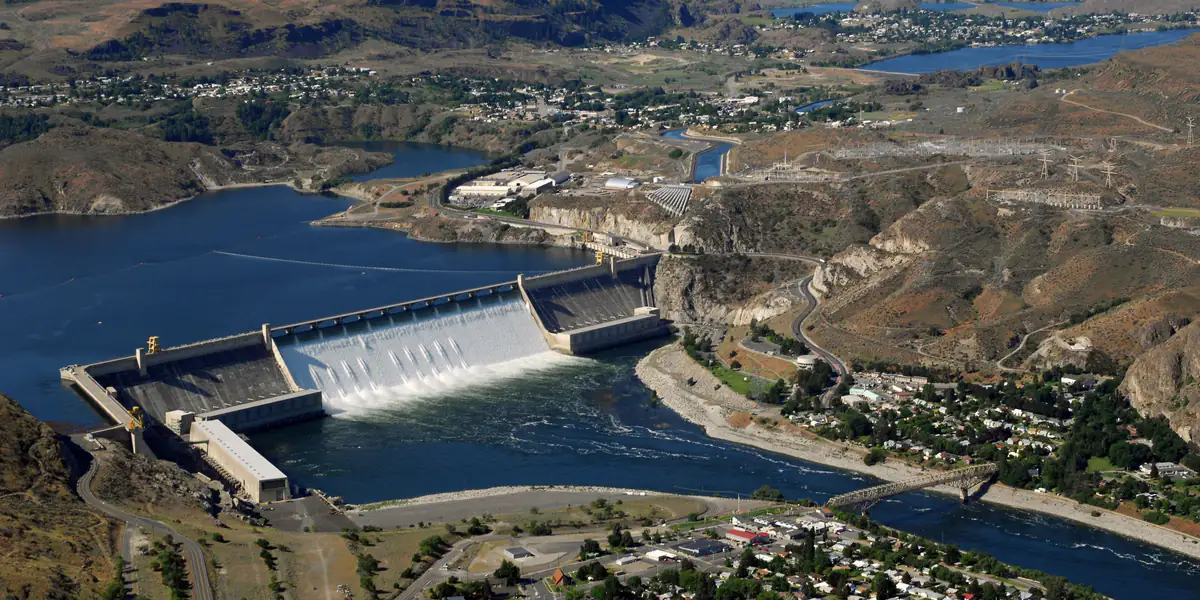
From the beach, a reservoir and a natural lake look the same. They are not made the same way, and that difference explains most of what you notice on the water: how much the level moves, the shape of the shore, where the fish are.
Made by nature, or by a dam
A natural lake fills a hollow in the land. In the United States most were made by glaciers, which scoured basins and left blocks of ice that melted into lakes: the Great Lakes, the Finger Lakes such as Seneca Lake, and the thousands of lakes of Minnesota, Wisconsin, Michigan, Maine and New Hampshire. Others fill a volcano’s caldera, like Crater Lake, a basin dropped by faults, like Lake Tahoe, an old bend of a river, or a sinkhole, as in Florida.
A reservoir is a lake made by a dam across a river. The water backs up the valley behind it and floods the river’s side valleys too. Most big U.S. reservoirs were built in the 20th century by the Army Corps of Engineers, the Bureau of Reclamation, the Tennessee Valley Authority and power companies, for flood control, hydropower, water supply, irrigation and navigation.
Why the South and West are full of reservoirs
The glaciers stopped roughly at the Ohio and Missouri rivers, so the South and most of the West have few natural lakes. Nearly all of their big lakes are reservoirs: Lake Lanier, Lake of the Ozarks, Lake Mead, and almost every lake in Texas, Oklahoma and Tennessee. Caddo Lake is the best-known exception in Texas: it began as a natural lake behind a huge logjam on the Red River. Most of the lakes on Lake by Lake with a daily level reading are reservoirs, because that is where dams and gauges are.
Why their levels behave so differently
A natural lake rises and falls with rain, snowmelt and evaporation, and spills out over its natural rim or outlet. Its level usually moves slowly and by a few feet at most. Many have a small dam at the outlet that only fine-tunes the top: the dam at Tahoe City controls only the top 6.1 feet of Lake Tahoe, and the Lakeport Dam keeps Lake Winnipesaukee within a couple of feet.
A reservoir’s level is managed. It has a full pool set by the dam, and it is drawn down and refilled on a yearly plan, by a few feet on some lakes and by 50 feet or more on others: see what full pool means and why lake levels drop. In a long drought a big western reservoir can fall more than 100 feet.
Shape, water and fish
A reservoir is a drowned river valley: long and branching, with arms up every creek, the deepest water near the dam, and the old river channel, roadbeds, standing timber and sometimes whole towns on the bottom. Water flows through it, so it carries mud from upstream and slowly fills in at the upper end. Anglers fish the creek channels, points and flooded timber, and the cold tailwater below the dam often holds trout.
A glacial lake is usually rounder, with the deepest water often in the middle of a basin, and with less water flowing through it, it is often clearer. Its fish live along weed beds, rock reefs and drop-offs: walleye, northern pike, muskie and smallmouth bass country.
Which is your lake?
Each lake page on Lake by Lake says whether the water is held by a dam, and gives the dam’s name, height and year where the National Inventory of Dams has it. If the page shows a full pool and a seasonal pattern of drawdowns, it is almost certainly a reservoir, whatever its name.
Questions
Is a reservoir a lake?
In everyday speech, yes, and most reservoirs are named lakes. Strictly, a reservoir is a lake made by a dam across a river, while a natural lake was formed by glaciers, volcanoes, earth movements, rivers or sinkholes.
Why are so many reservoirs called lakes?
Mostly custom. Lake Lanier, Lake Mead and Lake Cumberland are all reservoirs, named as lakes by Congress, the agencies that built them or local people. Lake sounds better on a road sign than reservoir, and the names stuck.
Can a natural lake have a dam?
Yes. Many natural lakes have a small dam at their outlet that controls the top few feet. The dam at Tahoe City controls only the top 6.1 feet of Lake Tahoe, and the Lakeport Dam keeps Lake Winnipesaukee within a couple of feet of its target level.
Are there natural lakes in Texas?
A few. Caddo Lake on the Louisiana line began as a natural lake, backed up by a huge logjam on the Red River, though a dam has controlled its level since 1914. Nearly all the other big lakes in Texas are reservoirs.