Guide · updated November 10, 2026
What “Full Pool” Means for a Lake
Full pool, normal pool, conservation pool, flood pool and dead pool explained — and why a reservoir can be “full” and still rise.
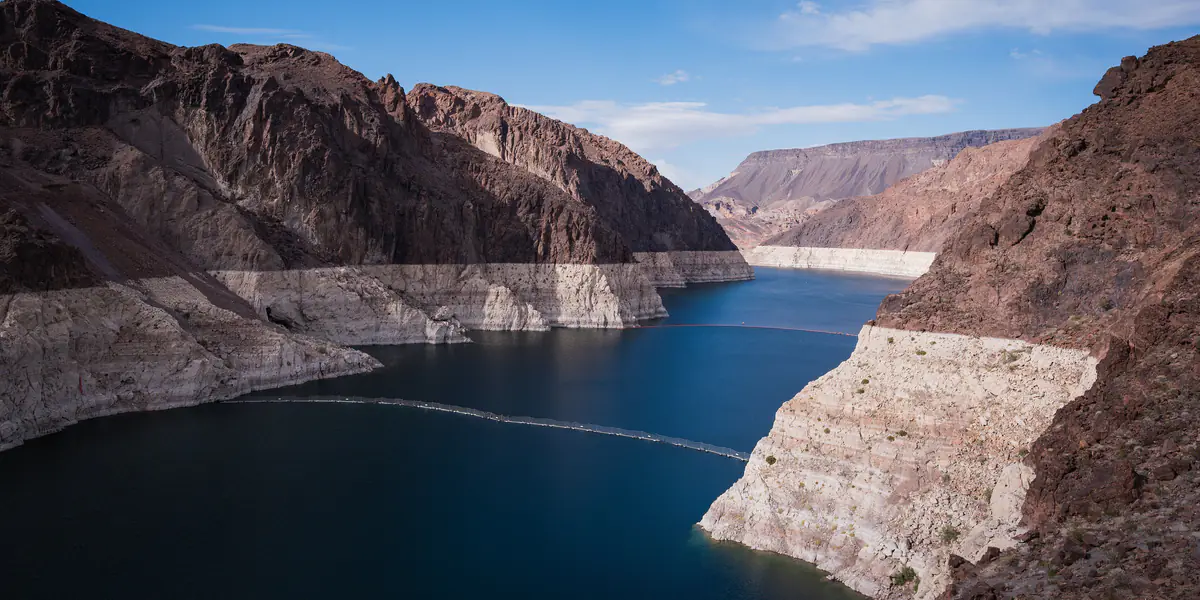
Full pool is the water level a reservoir is managed to hold when it is full for normal use. On most U.S. reservoirs it is the top of the conservation pool — the slice of the lake that stores water for drinking supply, hydropower, navigation and recreation. When a lake page says “3.2 ft below full pool”, it means the water surface is 3.2 feet lower than that mark.
The pools of a reservoir, from bottom to top
- Dead pool — water below the lowest outlet. It cannot be released from the dam, only lost to evaporation.
- Inactive or minimum pool — the lowest level the operator plans to go. Below it, hydropower units stop or water intakes are exposed.
- Conservation pool — the working storage. Its top is the full pool (also called normal pool, top of conservation or, on power lakes, full pond or top of power pool).
- Flood pool — the empty space above full pool kept for floods. Water stored here is released as soon as the river downstream can take it.
- Surcharge — water above the flood pool during an extreme flood, when the spillway is running.
Why the name changes from lake to lake
Each operator uses its own words. The Army Corps of Engineers says top of conservation pool or summer pool. Duke Energy says full pond and measures its lakes on a local scale where 100 ft is full. TVA publishes a June 1 target. California reports storage as a percentage of capacity rather than feet. On Lake by Lake we show the operator’s own term next to the number, and we name the source on every lake page.
Percent full is not the same as feet below full
Reservoirs are shaped like funnels: wide at the top, narrow at the bottom. The top few feet hold far more water than the bottom few. A lake that is 10 ft below full can still be 80% full, and the last 10% of storage might span 40 ft of shoreline. That is why Texas and California publish percent full (from storage) and most other operators publish elevation.
Is “full” good?
For boaters and anglers, a lake near full pool usually means every ramp and beach is usable. A few feet below full, the shallow ramps close first. On Lake Lanier, the Army Corps lists a minimum usable level for each ramp; with the lake about 8.5 ft below full pool in November 2026, roughly one ramp in five was already too shallow — see which Lake Lanier ramps are usable today. Well below full, hazards appear: stumps, sandbars and old roadbeds. Above full pool, ramps and parks can flood and the lake carries debris.
Questions
Can a lake be above full pool?
Yes. Flood-control reservoirs store extra water above full pool after heavy rain, then release it over days or weeks. While that happens the lake is “in the flood pool”.
Why is full pool different in summer and winter?
Many Army Corps and TVA reservoirs have a seasonal guide curve. They draw down in fall to make room for winter and spring floods, and refill to summer pool for recreation and power.
Do natural lakes have a full pool?
No. A natural lake rises and falls with rain, snowmelt and evaporation. Some are held near a target by a small outlet dam or a legal limit (Lake Tahoe’s is 6,229.1 ft), and Lake by Lake shows that limit when it exists.